
SpaceSim - Astrophysical Simulation Software CD Key
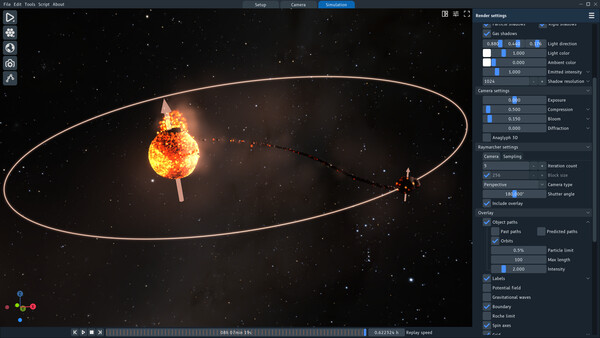
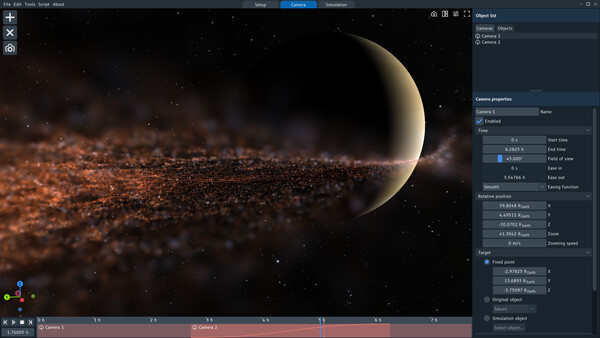
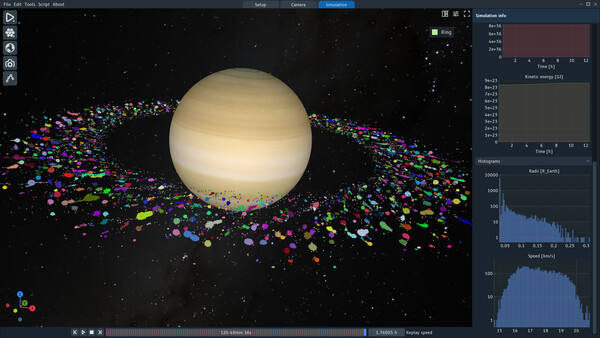
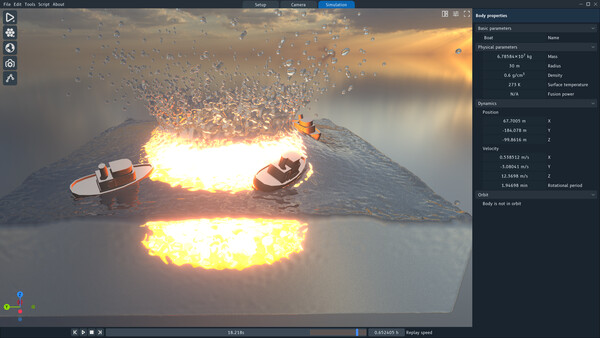
SpaceSim is a non-realtime particle-based astrophysics simulator that lets you recreate and explore events like planet impacts, ring formation, and galaxy interactions. Customize planets, stars, disks, and more with textures or Lua scripting, visualize gravity and particle data, and render with real-time or raymarched engines.
Looking for the best price for SpaceSim - Astrophysical Simulation Software? Compare offers from 1 stores on CheckGamePrices to find the cheapest Steam key available. Right now, the lowest price is 14.99$ at Steam.
Current Lowest Price
14.99$

Visit store
Release Date
15 Dec, 2025
Publisher/Developer
Pavel Ševeček
Reviews
Steam: 95.16% positive (275/289)
Metacritic: -
Recommended games




SpaceSim - Astrophysical Simulation Software Steam Price History Chart
Current Steam price: 14.99$
Lowest Steam price ever: 9.74$ — 2026-10-08
Lowest Steam price ever: 9.74$ — 2026-10-08
Loading SpaceSim - Astrophysical Simulation Software price history chart...
SpaceSim - Astrophysical Simulation Software description
SpaceSim – Astrophysical Simulation Software
SpaceSim is a particle-based astrophysical simulation and rendering application designed to make scientific-style simulations accessible on a desktop PC or laptop. It uses the same general approach as research simulations (simplified and at lower resolution), paired with an intuitive interface that doesn’t require advanced math, physics, or programming knowledge.
Important: SpaceSim is a non-realtime simulator. While small tests can run quickly, high-resolution scenarios with millions of particles may take hours to compute. It is also not a game—there are no missions, progression, survival/sandbox loops, or traditional gameplay mechanics. Instead, it focuses on building, simulating, visualizing, and replaying complex physical events.
Simulate gravity, collisions, and fluid-like deformation
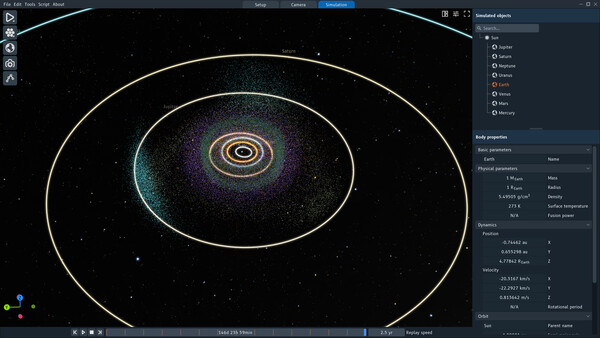
Objects are discretized into particles that interact via gravitation and collisions (fluid dynamics behavior by solving Navier–Stokes). Mix deformable bodies with rigid objects to balance realism and performance. This particle-based approach is well suited for astrophysical scenarios such as planetary formation in protoplanetary disks, large impacts, debris evolution, and galaxy interactions.
Recreate famous scenarios—or explore “what-if” physics
Start from realistic setups inspired by scientific literature (e.g., Moon-forming impact, Saturn-like ring formation, DART-style kinetic impact) or experiment with hypothetical cases such as extreme collisions and exotic material combinations.
Powerful customization and scripting
- Multiple object types: planets, stars, asteroids, disks, clouds, galaxies, and more
- Editable parameters: geometry, materials, appearance, and simulation behavior
- Procedural textures and support for custom surface images
- Lua scripting for custom objects and complete simulation systems
Advanced visualization and rendering
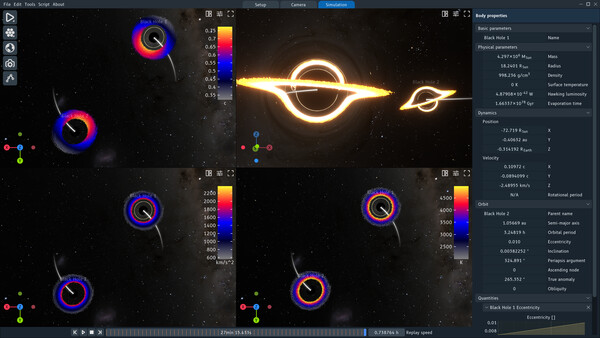
Analyze results with particle coloring (velocity, pressure, material, and other quantities), gravity well visualization via potential fields, and tools like Roche limit display for orbital stability insights. The renderer also supports black holes and white holes with gravitational lensing for realistic warped accretion disks, duplicated background imagery, and Einstein rings.
Workflow features for experimentation and production
- CPU and GPU simulation solvers with optimized gravity using the Barnes–Hut algorithm
- Simulation history for full replay and iteration
- Two render engines: Real-time and Raymarcher
- Camera paths with object tracking
- Built-in video recording (H.264) plus export options including Alembic and OpenVDB